(Yes, puns are necessary). Yin yoga is fast becoming a regular name in the contemporary yoga world, along side Bikram, Vinyasa and Ashtanga. So let’s delve in to see what it may have to offer regular yoga goers and athletes alike.
The roots of Yin
Yin yoga, came to us through perhaps an unusual source, modern martial arts. An American martial arts instructor, Paul Zink, used a combination of yoga poses and martial arts together and found they complimented each other to improve flexibility as well as strength in the art, called taoist yoga. His students Paul Grilley and Sarah Powers really resonated with the practice and seen the immense benefits to students, and so went on to develop a purely yoga based practice, what we now offer as Yin yoga. It utilises many traditional yoga poses so still has links to traditional hatha yoga, but it uses them slightly differently, with small variations, the focus is tweaked and the poses are long held, allowing us to marinade in the postures for enough time and breaths to feel the fascia, and our own resistance, release. If you know what fascia is you can skip to the next part. Fascia is basically the webbing that holds our entire system of muscles, bones, ligaments, organs, vessels, nerves .. together. It is like our unperceived shell, connected, woven and intertwined through every inch of our body and our nervous system. It gives us our shape. It is connected like a chain, through our entire system. Fascia, like muscle, can become dysfunctional, one link out of whack can have knock on effect further down the chain, referring pain or tension through the body. Fascia can be effected positively through Yin yoga, to release and re-align.
Classes usually only consist of a minimal amount of actual poses, so unlike most modern takes on traditional yoga which sees us “power” or “flow” through a set of sequences with speed, Yin is a much slower pace. Part of the challenge for most of us of a Western mindset is simply allowing ourselves to come to this state of heightened stillness, staying in the pose with full awareness of all the sensations the body throws at us for the duration of the held posture. The poses again may only be held for 90 seconds or up to 5 minutes depending on the pose and your experience, but the effect on your body and mind can be profound. Having explained the idea, I will emphasise that although in theory the practice sounds very similar to say restorative yoga where we hold poses for longer periods, the practice is very different, in restorative we are aiming to rest, restore and enjoy being supported by various props in an almost lazy yoga way. Yin is an altogether different beast. We work on the ligaments, fascia and staying with some uncomfortable bodily sensations and emotional ones too. You may actually feel slightly fragile and delicate for a minute after a long held pose but with an experienced instructors guidance and care you will feel an immense release of constriction, tightness and a yielding of the body to the moment. This makes it excellent for the purpose of martial arts or for those who work out and find while they have excellent strength and endurance they may feel flexibility and ease of movement could improve. It also suits those who may enjoy a good meditation practice or a regular yoga routine, the ability to stay with what is happening and not take our attention away from the sensations in the body is a huge aspect of the challenge of Yin, and its benefit of course. It is not for the faint hearted but it is so very worth the effort!
Yin Yoga is simple, but simple does not mean easy.”
Bernie Clarke – book ‘Yinsights’
Where to find a class
Yin Yoga classes are thankfully becoming more freely available. In Wexford you can catch a class with Tania at Ashgrove yoga Sarah Dunlea Yoga also treats her students to some Yin on her regular mini retreats. Keep an eye on her facebook page for these at various locations in Wexford. Yoga by Vickileigh run a weekly class in Gorey town on Tuesdays at 8.15 details here.
If you have practiced yoga, or have read anything about it recently, you likely know and have some understanding of the benefits of a practice, to which people can both anecdotally attest to and increasingly is being backed by ‘science’. I am not here to convince anyone of the benefits that yoga can have for adults, but Yoga also has proven benefits for children in increasingly stressful classrooms. Our children are facing daily downloads of news on topics such as the impending climate crisis, they are dealing with issues we could never comprehend in an ever increasing tech saturated world, and have far more complex special needs in schools and now more than ever young people need ways to regulate emotions and even thrive in our modern landscape. According to Yoga 4 schools, an American based school programme, there is mounting evidence of the value of mindfulness and yoga practices in the classroom. “In summary, a growing number of scientific studies suggest that yoga may enhance students’ mind-body awareness, self-regulation, and physical fitness which may, in turn, promote improved behaviour, mental state, health, and performance, to dive further on the subject check out the links to these scientific studies- (Butzer et al., 2016; Ferreira-Vorkapic et al., 2015; Khalsa & Butzer, 2016; MLERN, 2012; Serwacki & Cook-Cottone, 2012).” And in Ireland it is now being recognised and called for to be added to school activities. The familiar Schooldays.ie shared this article about the benefits for our little ones, “Kids yoga helps to maintain your child’s natural flexibility, encourage good posture and digestion and develop the focus needed to perform well in school. Yoga improves self confidence, helps your child to develop a healthy body image and allows them to express their emotions in a physical way.” I don’t think anyone would refuse those benefits! Conversely you may also have read the articles in various papers last year from The Journal, here, to the Irish times, here, and numerous other publications, about a particular Bishops’ opinion in the form of a letter to local schools, backed by comments from the pope, about the consequences of practicing non catholic origin, yoga and meditation in schools. The letter included this line “yoga is not of Christian origin and is not suitable for a parish school setting”. So what is it that really makes the Catholic church so afraid and so vocal on this subject? Well let’s look at what the pope actually said on the subject in 2015, which the Waterford Bishop is referencing. The pope is actually quoted as saying “You can take a million catechetical courses, a million courses in spirituality, a million courses in yoga, Zen and all these things. But all of this will never be able to give you freedom” . It is a quote that also mentions catechism courses which is as described by wikipedia for those unfamiliar “a book that explains the beliefs of the Christian religion by using a list of questions and answers”, (although the bishops letter appears to have left out the reference to Catechism studies). I don’t believe the pope is saying not to study the catechism if you’re Catholic, but that these activities alone, will not give you freedom from suffering, that you must still live your beliefs and embody the teachings. So why has the Irish church run with the yoga and meditation angle of this quote and run away with it to the point of saying it should be banned from schools? The Bishop himself suggests that it is due to yoga’s non Christian origins. Yes, it is a practice associated with the religion of Hinduism. While zen meditation is associated with Buddhist traditions. (There is a school of thought that yoga pre-dates hinduism, but that is for another days debate.) And there are other religions associated such as Jainism and Sufism. So then with the monumental rise in popularity of yoga and meditation, where are all the Hindu converts in Ireland and globally? I personally know no one, even in the yoga teaching community, that includes those who have spent many years studying yoga and the Vedic texts, who has been compelled to convert and I know of no rush to sign up to the religion of Hinduism. So does that argument therefore ring true, somehow the study of yoga will lead to so many lost lambs? According to the PEW research centre there is expected to be a growth in hinduism outside of India from now until 2050, but this is due to immigration and birth rates within those communities, growing inline and against a background of overall world population growth, but not from mass conversions. And interestingly, Buddhism is set to see a decline in numbers, from 2040 to 2050, with an ageing population. So again this fear of people being converted does not seem relevant given numbers have been unaffected by huge conversions despite decades of yoga in the west. Perhaps you are wondering, with no disrespect to anyones beliefs, what the relevance of one Bishops opinion is or why the fuss? I fear the impact of such statements, is still far reaching. Many people are hugely devotional in their beliefs to the church and will take such statements very much to heart. The bishop is after all a prominent representative of the faith and people live by their faith, earnestly and honestly and I fully recognise and honour that. There is also still a large influence on school boards of local clergy, who are in turn responsible to the Bishops, and any state school will have a priest as a chairperson on their board of management. I have spoken to children’s Yoga teachers who have come up against this very issue when hoping to share their abilities and teachings in school situations. In fact one teacher has been through the process of vetting and consideration on three separate occasions with different parish schools and hit the proverbial brick wall when it was brought for approval before school boards to then be dismissed outright. She confided that she was also asked to change the name of her class from “yoga’ to a more palatable name to appease the board. I have heard from yoga teachers who have been observed and eyed suspiciously in community halls, for any hint or whiff of a “dark” or alternative spirituality in their yoga classes so they can be refused any further use of the facilities. I have read flyers in my local area that were handed out to passers by and delivered to post boxes, presenting the argument that yoga opens participants up to demonic possession and wicked behaviours of the flesh, yes in this day and age! Rural Ireland probably suffers this even more than our larger cities. Further still, all this may plant seeds of suspicion in the mind of the regular person before they even attend a class or allow their children to join without them even being aware, just enough of a question to linger in the back of the mind, enough doubt to lean away. So it really does matter.
“In the quiet, God slips in.”
Heidi Schlumpf
Yoga and God. Certainly being Catholic and practicing yoga are not mutually exclusive ideals. I know many devout people who find themselves closer to God and their faith with a daily yoga practice. People similar to this lovely lady, Heidi, who puts her experience so eloquently in an article in the National Catholic Reporter about how practicing yoga makes her a better Catholic. “For me, anything that slows down my hectic life is a good thing — and not just because it aids relaxation and de-stresses. Meditation is just another name for prayer. In the quiet, God slips in. That’s why so many religions have some sort of quiet, meditative prayer practice. For some Catholics, it’s praying with the Blessed Sacrament. For others, it may be a centering prayer. Still others find it on their yoga mats.” I can agree, my practice makes me a better human.
‘Structurally the architecture of the church is designed to maintain the invisibility and the powerlessness of women.’
Dr. Mary McAleese
I ask then, what is the fear? My thoughts are much more in line with who is practicing yoga? Roughly 80% of yoga participants are female, a fact you may have witnessed if you have attended any yoga classes, workshops or teacher trainings recently. It is a practice which sees a considerable amount of women, gathering together, meeting, sharing and inspiring each other, raising each others spirits and collectively healing. I would speculate this is probably quite a suspicious fact not gone unnoticed by a mainly male dominated, hierarchical system that still is the church. I do not wish to alienate men here, in fact, I welcome the male energy to join in the practice, as male energy receives the same benefits and love as does the feminine, our children can witness this balanced healing opportunity and everyone wins. However women have always been a worrisome force to be managed and maintained, especially regarding health and the healing arts being in women’s hands. After all we are fully aware of the trials and tribulations of female healers and anyone who seemed to have independent ideas, at the hands of the church in 15 & 1600s. As referenced here from the History channel. “Single women, widows and other women on the margins of society were especially targeted. Between the years 1500 and 1660, up to 80,000 suspected witches were put to death in Europe. Around 80 percent of them were women thought to be in cahoots with the Devil and filled with lust. ” Gendercide, theres that 80% again. The most aggressive elements of the witch hunts were driven largely by the publication of a hand book, Malleous Maleficarium, ‘the hammer of the witches’, written by two monks. This handbook was not the first ever written on the supposed power of witch craft but it is believed to be the first to assign the role of malignant witch to the specific gender of women, women being more susceptible to Satan’s temptation apparently. The witch hunters guide published by Catholic inquisition authorities in 1485-86. “All wickedness,” state the authors, “is but little to the wickedness of a woman. … What else is woman but a foe to friendship, an unescapable punishment, a necessary evil, a natural temptation, a desirable calamity, domestic danger, a delectable detriment, an evil nature, painted with fair colours. … Women are by nature instruments of Satan — they are by nature carnal, a structural defect rooted in the original creation.” Whoah, right? Strong words that were incredibly popular, as the book was only out sold by the bible during the period, placing a solid number two in the book charts and with 30 odd variant editions, for almost 300 years. Our own Dr.Mary McAleese has been very vocal on the continued denigrated position of women in the church, as she said recently ‘structurally the architecture of the church is designed to maintain the invisibility and the powerlessness of women.’ This article from the Irish Times delves deeper on her opinion and it is a powerful one. In it she reveals and “quoted from a book of theology ‘Love and Responsibility’ by the late Pope St John Paul II which stated that in the act of sex in a marriage, the woman “is a comparatively passive partner whose function it is to accept and experience. For the purpose of the sexual act it is enough for her to be passive and unresisting, so much so that it can even take place without her volition while she is in a state in which she has no awareness at all of what is happening – for instance when she is asleep or unconscious.” She noted that the late Irish theologian Fr Seán Fagan, who was censured by the Vatican, had questioned Pope John Paul on this saying it sounded like rape. “What happened? Pope John Paul becomes a saint. Seán Fagan becomes silenced. That’s our church,” said Professor McAleese.” Again, very recent history, his papacy ending in 2005.
“Is the issue of yoga and the church really a misogynistic one? “
You may now be questioning the link between a predominantly female compelled yoga movement and the stance of the church, and ask “is the issue of yoga and the church really a misogynistic one? “ I can only point to the fact that when community halls and centres around the country provide karate classes, for example, for children and adults alike, a martial art for which Religion was crucial to its development and is extricably linked. And yet there is seemingly no outcry from the church on the matter? A quote from this Website called “Blackbelt” describes karates’ Buddhist beginnings as follows, “It (Religion) was crucial in the historical development of many arts, and it continues to dictate the ways in which many students think and act during practice sessions. More than a few Western students have converted to an Eastern religion simply because their martial art grew from that spiritual tradition. But does the fact that a martial art germinated in religious soil mean all practitioners have to abide by those beliefs?”. Karate, while teachers of the art here, I am sure, welcome both sexes to participate, does have as a general rule more male teachers and students than female, it’s a general fact. There is no question of its intentions or value as an activity for children, its known to have far reaching positive effects on self confidence, discipline and physical health for children but it doesn’t seem to draw the same attention as to its religious origin and the spiritual ramifications for its participants, in the same way that yoga has attracted such scrutiny. Yet it is yoga that seems to strike the fear of, well, God into the church.
Today, women are still struggling with their position within a modern and still very male dominated society outside of the church, even in Ireland. We may have stepped out of the ‘burning at the stake’ inquisition times and Mother and baby home era (although the homes were in operation until frightening recently in our history, Bessboro in Cork only closed in 1996, and there has been very little co-operation from the church regarding compensation and culpability on many abuse issues.) Scratch the surface and equality is still a far off utopian daydream. Equal pay is still an illusive wisp clutched at by hard working hands. Modern mothers are often expected to work like they don’t have children, and mother like they don’t have careers, exhaustingly juggling both. Equal numbers in powerful roles within the workplace and politics is an ongoing battle. But no where, other than the church is the division of the genders still as prominent and brazen as ever. So, yes, I do see a link to the church’s fear of yoga in school and who is the predominant practicer and provider of Yoga today.
The time has come. In a time when we are without doubt or sensationalism, in the midst of a mental health crisis that effects so many and at more tender ages, when stress and anxiety has creeped in to every facet of life, when government mental health provisions or lack thereof is at the forefront of most peoples voting agenda in Ireland in election 2020, will we still allow the church to remove one more proven effective tool from a dwindling, understocked and under financed tool kit for providers because it didn’t originate in the Vatican walls? Should we still be paying attention to the church on whether we should have yoga stretches and mindfulness in schools? Whether meditation and mindful breathing techniques for stressed children should be a taboo despite the many, many proven benefits? If community halls should open the doors to facilitate peoples desire to participate in an ancient healing art? Fundamentally I think the power to decide what we do within our schools or community halls should no longer be dictated by men who fear women gathering in groups or are disconnected from the task of caring for children in a modern world. Yoga can benefit all who are willing to participate, young, old and of every gender or religion and that is its charm and beauty.
As you begin to delve deeper into the world of yoga and modern spirituality, you will probably hear the term mantra used a lot. The word ‘mantra’ is a little bit of a buzz word among yoga advocates and spiritual celebrities and it seems to be akin to repetitive positive thinking, perhaps, I feel an overly simplistic interpretation of its broader meaning but certainly on the same page.
A mantra is what we chant, chanting is repeating the mantra. These are the sacred words or prayer performed in song, rhythmically and repeatedly. Chanting in its ancient form is part of the process of “pratyahara”, the withdrawal from the world of the outwardly senses, to the inner terrain of the Self. Mantras, in yogic terms are traditional to the Sanskrit language, one of the most ancient root languages known, and is the language many mantras are still performed in today. Some traditional mantras are merely sounds, seed sounds, ‘Om’ being the most well known of them, that have no verbal translation yet have so much meaning and connection to the essence of what they represent, ‘Om’ being the vibration that encompasses all of consciousness itself in one sound, pretty powerful for such a small word. Mantra can be chanted to various deities, to call on their wisdom or to help you embody what they represent. It is connected with deep held intention, transcendental embodiment and vibrational transformation. After all, we are merely vibration, mantra is one way to alter that vibration, we are tapping in to our personal frequencies and being our own vibrational conductor.
Most traditions from all around the globe have a form of chant, from Hawaii, Native America, Africa and Aboriginal Australia. We may be familiar with Gregorian chant, the Roman Catholic form of repetitive sung prayer usually in Latin. It is pretty apparent from the use of chant through the many traditions and ages, that it holds some truly powerful spiritual significance.
Good vibrations.
So looking a little further into chanting mantras, why might this practice be so powerful?
Through the more recent work in quantum physics, we may be going some way to help explain the reasons why. I’ll give you my very unscientific interpretation of the reasons.
All matter is, simply put, just vibrations, oscillating at various levels or frequencies. And sound of course, is pure vibration. This piece from The Scientific American jokingly refers to how the “hippies” had it right, good vibrations and all that is truth and more easily understood by all. Check out the article here.
‘Well, we agree that vibrations, resonance, are the key mechanism behind human consciousness, as well as animal consciousness more generally.” Scientific American.
So we can change our own vibration, tap in to our consciousness, through sound. We know words are also very powerful, the meaning and the intention all have their effects, they have their own energy (just look at how effective an expletive word can be when you need to release a moment of quick anger or pain when you stub your toe in the dead of night).
The ancient language of Sanskrit is still used for chanting purposes today. Sanskrit is a uniquely resonant language, it has 49 letters, 35 of which are soft sounds, making it a wholly different vibrational and resonant experience to chant and hear than more modern languages. It has also been around a real long time, which allows us to echo back to our ancestors no matter our origin. However you can use mantra and chant in any language you desire, you don’t even have to understand the full meaning of the words, you sense their energy and sacredness. Then we look at communal chanting.. this is where it gets more interesting. Vibrations effect and spread around them synchronising with other objects of vibrating frequency, creating a heightened effect. Pretty effective way to spread an idea.
So it is all about vibrations, but it’s also about the type of vibrations and, most importantly, about shared vibrations. If you wish to take this powerful practice to the next level, group chanting is an energising experience which I can not recommend highly enough. Check out the exquisite offerings and opportunities to be lead in a safe group environment, suitable for everyone of every voice and experience level, available through the wonderful facilitator Yasia. Information on events around the Bray and Dublin area on her page here.
Working with mantra is still something I am exploring. I have only scratched the surface of this beautiful tradition so please forgive me if my interpretation is unsophisticated. My own personal experience has helped me clarify however why using a mantra and chanting is so significant to me and why it may help you.
Intention – even if the mantra is a seed sound or a language you do not know, it is your intention, your belief and your cherished hope that is so crucial an element.
Vibration and frequency – this is linked inextricably to the intention. The metamorphosis of your vibration can lead to many changes in your thought patterns, beliefs, the physical energy that you emit and so your circumstance.
Developing my voice and the spoken word is part of the process . For me, finding my voice and using my voice, something I struggle so frequently with, a disconnection from which has plagued me through my life, has been an utter joy. It is a huge missing part of my personal tapestry, my disenchantment from the power of my own voice and speaking my truth. I will look at this in another post as it is a significant part of the conditioning particularly of women in our society.
If you would like to begin to use traditional mantra in your practice. Here is a little mantra I have had the pleasure of exploring and is a lovely place to explore from.
I have drawn my inspiration from the book “Awakening Shakti” by Sally Kempton, who wonderfully and sensitively explores the goddess’s from Hindu traditions to help us in the west understand the vast history of these beautiful figures. Also from the book and CD by Thomas Ashley-Farrand, Healing mantras. Learn Sound Affirmations for spiritual growth, creativity, and healing. Giving us a practical and very accessible guide to mantra.
A mantra to Lakshmi.
This mantra is a powerful one for drawing abundance to your life. Lakshmi – a deity, is a goddess in the Hindi tradition. I am not Hindu myself, so to me, she is simply the embodiment of abundance, in the form of a somewhat relatable earthly figure.
Lakshmi embodies certain qualities which we would all at some point or in some way find desirable in our lives. Abundance, whether it be an abundance of love, health, vitality, joy, money, peace, or whatever you feel is scarce in your world, that you would like to attract more of.
The words are as follows-
Om Shrim Maha Lakshmiyei Swaha
(Aum Shreem Ma-ha Lak-schmee-Ya Swa-ha )
When I use this mantra I envision Lakshmi as the beautiful dark haired Goddess she is often depicted as, dripping in a red sari, precious gold and red rubies lavishly adorn her radiant skin, she is gazing with quiet confidence and pure open generosity in her face. She is rooted in contentment, a knowing that all is well and always will be, I suppose a kind of self assuredness that comes with knowing abundance in your life. Lakshmi, to me, is also generosity, a kindness and ability to give freely that comes from a connection to the source, knowing no scarcity or lack. She is sustainability, health, love, joy and comfort.
I begin to feel warm golden light flooding through my body. She is honey in my veins, luxurious cloth on my skin, radiance in my eyes, vitality in my entire being. She is fine food, opulent decorative surroundings, decadence in all manner of ways that is always tasteful.
As I repeat the mantra, I expand the embodied sense of confidence, contentment, abundance to my very cells. Even the words of the mantra are rounded and soft, like the essence of Lakshmi. I carry this sense with me for as long as I can. Feeling abundance is already with me, I already have it. With this comes a sense of gratitude and grace. To me the gratitude is as important as the ability to embody the sense of abundance. I then imagine sharing this abundance, spreading the light, the joy the love through my body to those around me, the earth, mother nature or wherever it is I may be. This represents the expression of Lakshmi that is her generosity and lack of fear of limited resources and scarcity which we can be lead to feel in this world right now.
I hope you will find the beautiful potential power and grace of mantra and voice work as helpful as I have. Enjoy, be playful, loosen up and let your voice soar!
There are many festivals which were once celebrated throughout Ireland from the Celtic calendar that have fallen by the wayside, so few have survived in to the modern times, once they were an integral part of the cycle of the year, as we were so closely woven to the ebb and flow of the seasons. One celebration has continued and is currently seeing a fresh following, one it so richly deserves. Imbolg or Lá Fhéile Bríde, celebrated midway between the winter solstice and spring equinox on February 1st.
Brigid’s beginnings.
Originally Brigid was believed to be a pagan Goddess of the Tuatha De Danan (a famed mystical Irish race) she is associated with healing, fertility, inspiration and poetry and protector of the water ways. “Imbolg“, in the belly, acknowledges the ripening of earth to her youthful “maiden” and fertile stage, the quickening of the season towards the light and the first whisper of spring. Brigid was thought to sweep across the land at this time, her touch awakening mother earth from her winter slumber and traditionally people would leave out clothing (white or green) such as scarves, to be blessed by Brigid, to be used for healing purposes, as she brought fertility and light back to the land after the depths of cold, long, barren winters. People would weave the fire wheel symbol or Brigid’s cross, traditionally using reeds or willow. This would be hung over a hearth or beside a door to protect the inhabitants and again receive the blessing of Brigid for a year of health and abundance to come. There are many other traditions associated with this turning of the wheel to be explored. Brigid became Christianised and was incorporated into the traditional religious calendar as the feast of St.Brigid of Kildare, a female patron saint, and the patron saint of fallen women, which is still celebrated today. Interestingly in Ireland most people regard February 1st as the beginning of Spring, while the rest of the Northern hemisphere consider March the first month of Spring.
Brigid’s reawakening – auspicious timing.
“hope after the long darkness of disconnect from nature and ultimately ourselves”
In a time when the Mother earth is in the hour of precarious and desperate need for healing and the loving caress of a Goddess, Brigid is finding herself and her ideals being called upon once again, unearthed in that hour of need. Our lands are desperate for the blessing of Brigid, her protection of the water ways, her healing love and once again people are feeling the urge to pay homage and reconnect, through her, to the turning of the season and the call to honour our Mother. She brings hope with her, as she did to the people longing for the first faint echoes of spring after the long nights of winter, she may now be sending us a message of similar hope after the long darkness of disconnect from nature and ultimately ourselves.
Celebrating Brigid
Gathering with like minded souls to honour Imbolg and the Goddess Brigid and celebrate her bounties is a beautiful way to reconnect with this wonderful age old tradition with many festivities available for people to come together and celebrate. If you feel the call to honour and meditate on what Brigid represents in our modern world, or would simply like to try something new or meet some new friends, there are some beautiful offerings and ways to do so. The following are just a sample of the events being offered.
The lovely Sarah Fox in the Alchemy School of yoga, Cork is offering a bespoke workshop to honour the day. Sarah is a traditional herbalist and experienced yoga and movement practitioner with a wealth of knowledge on Celtic Irish traditions and a passion to match. Sarah is “offering a day long workshop of yoga, mindful movement, Celtic spirituality, story telling, craft and much more. ” You can find details and booking information here.
Another way to honour the moment is through communal singing. An event being offered in Bray on the eve of Imbolg, February 31st, invites all to “come sing your heart out”! And who doesn’t feel uplifted after belting out a tune? No need to be a gifted vocal talent here though. This is an opportunity to come, sing with Yasia, who is vocally blessed, accompanied by some beautiful drumming, provided by Sai Kiran. Yasia offers call and response chant, where she gently guides you with the words into an energetic tonal adventure, no experience necessary. The event is in honour of Imbolg this month but the nights are always popular. For more information see here.
And this gathering is also sure to delight, happening at Wexford’s Hook Head Lighthouse, New Ross, and is a community based festival which can be enjoyed freely. “During the weekend visitors to the lighthouse can enjoy a tasting table filled with flavours of local foods and hosted by the award-winning in-house kitchen team, art workshops and St Bridget Cross making with the Hook Lighthouse resident artist Rose, a talk on the meaning of Imbolc with storyteller Baya Salmon-Hawk followed by a visualisation. The Hook Lighthouse Eco Sheriff will host a talk on sustainability and recycling and share insights at the Hook Lighthouse Eco-Education Station and visitors can also enjoy a talk on Imbolc with storyteller Baya Salmon-Hawk and walk the maze to place wishes on the Imbolc Wishing Tree.” Events take place over the 1st and 2nd of February and include activities for children or an exclusive adult only dawn celebration at the lighthouse itself, for a fee. Details can be found here.
Simple ways to honour this time:
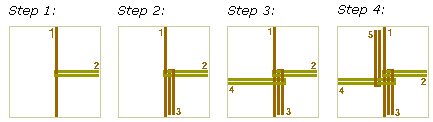
The traditional St Brigid’s cross or Brigid’s fire wheel. Willow can be used as a medium for creating the wheel, although any strong reeds can be foraged and used also, as long as you have a natural, pliable, strong reed, branch or grass then you can create your wheel. Follow the steps below.
Blessing of cloth It was believed Brigid would bless items of clothing, blankets, scarves or simple pieces of cloth of green or white, left in the moonlight, a window perhaps, which would be imbued with Brigid’s protective and healing aspects as she passed over the land with her awakening touch. These items were carried on the person for protection or for healing, worn around the neck or laid on the sick.
Lighting a candle. Imbolc is traditionally a Fire Festival and fire of many kinds is associated with it, the fire of creativity and inspiration, the protective hearth fire, and of course her fire wheel – the Brigid Cross, which heralds her as a Sun Goddess. Simply lighting a white candle can be a way to connect and mark this time. You can invoke Brigid with a simple prayer over the candle;
“Brigid, o’ firey arrow bright, Bring Your blessed healing light, Loving Mother, hear my plea, Attend this circle here with me! Blessed Brigid, who tends the flame, And hears Her children call Her name, Goddess of music, poetry, and art, Who brings inspiration and lifts the heart, Three Brigids–Maiden, Mother, Crone, Loving light of hearth and home, Come and bless this sacred space, By Your will and by Your grace, And as we merry meet and merry part, May I carry Your peace within my heart!”
Credit- Autumn Rose
However you decide to celebrate Brigid, do so with the intent to heal, ignite and inspire as she does and invoke all she embodies.
Discovering my place and my path through the landscape of Irelands alternative and yet ancient spiritual world has been a liberating journey for me. There is a vast richness of old ways intertwined with Eastern influence and modern twists and flourishes emerging in our corner of this Earth. Ireland has a history of paganism, Celtic wisdom and Christianity and has embraced rituals, practices and rites from around the globe and made them her own. Ireland is a fascinating place to be as we see offerings, teachings, gatherings and groups of all interests flooding the parched ground, creating space for healing, community and growth. It can be challenging to navigate the vast sea of options springing up, from new styles of yoga, Bhakti and chanting, shamanism to celebrations and devotional festivals. For those beginning their journey I hope to simplify, explain and guide to take any trepidation or apprehension out of stepping into these places and groups and adventures. Find your tribe and go in peace.
“The world is full of magic things, patiently waiting for our senses to grow sharper.”
― W.B. Yeats
So many times I didn’t do what I desired for fear, fear of not being enough. Countless times I missed out on opportunities for growth, for joy, for laughter. Not taking that swim in the ocean for fear of how my body appeared, not joining a yoga class for fear of not being as good as others, never trying for fear of failing, not measuring up spiritually or just fear of the unknown. I am still shedding that skin of fear and self doubt and niggling voices in my head. I am stepping into fear, every, damn, day. I hope this blog will help you, if you need it, to step in to your power. I am breaking the generational cycles of dysfunction and disconnection, to find my peace.
I am a yoga teacher, mother and a seeker. The path is never easy nor is it for the faint hearted but it is so very worth it.
I have adventured far and wide experiencing treatments, healings and offerings but by far Ireland is the most exciting place right now for anyone interested in spiritual enlightenment, healing, hope and camaraderie. Come and join me.




 Well Soul Yoga